Grand Canyon West vs South Rim From Las Vegas: Which One Actually Fits Your Trip

Travel Analysts

The choice isn't which rim is prettier — it's what you're willing to trade. Grand Canyon West is ~125 miles from Las Vegas (2–2.5 hours each way), home to the Skywalk, and easy to fit around a Vegas trip. The South Rim is ~275 miles away (4.5–5 hours each way) and delivers the deep, classic postcard views, but turns your free day into a 13–15 hour marathon. Short day with a controlled experience, or long day for the iconic view.
Explore the full guide & expert tips ➜West vs South Rim From Las Vegas — The Decision You're Actually Making
Two people book a "Grand Canyon tour from Las Vegas" without paying much attention to the rim. One comes back with the photo they've had in their head since childhood — the canyon opening into the distance at the South Rim, exhausted but glowing. The other comes back from Grand Canyon West thinking it was "nice but short and expensive," because they spent more time on the bus and in Skywalk lines than looking at the canyon.
Neither of them is wrong. What changed was the rim, and the relationship between three things: total hours in your day, actual minutes standing at a viewpoint, and the kind of place you end up in — a tribal experience park versus a classic national park.
So the honest question isn't "which rim is better." It's: do you want an intense, compressed memory that fits neatly into a Vegas-centered trip, or do you want to see the canyon "for real" even if it turns your one free day into an endurance event?
The geography decides most of it. Grand Canyon West sits about 125 miles from the Strip — roughly a 2 to 2.5 hour drive each way. The South Rim is about 275 miles out, which is 4.5 to 5 hours each way before you account for traffic, stops, or a slow pickup. That single difference cascades into everything else: how early you're picked up, how fresh you are at the canyon, and whether you have anything left for a dinner and a show that night.
WEST VS SOUTH RIM
| Grand Canyon West (Skywalk) | South Rim (National Park) | |
|---|---|---|
| Distance from Las Vegas | ~125–130 miles | ~275–280 miles |
| Drive time each way | 2–2.5 hours | 4.5–5 hours |
| Total day (door to door) | ~7–9 hours | ~13–15 hours |
| The view | Striking, but concentrated at a few points | Deep, wide, classic postcard canyon |
| Signature feature | Skywalk glass bridge (no personal cameras allowed) | Mather Point, Yavapai Point, open rim walks |
| Atmosphere | Tribal experience park — shuttles and timed stops | National park — pine forest, room to wander |
| Relative price | $–$$ (bus); $$$ (helicopter add-ons) | $$ (large-group bus); $$$ (small-group/deluxe) |
| Best for | Short on time, families, Vegas-centered trips | Photographers, first-timers chasing the iconic view |
| Hardest on | Budget vs. time at the rim ("felt short") | Energy — mostly a day of driving |
What Grand Canyon West Offers When You Go From Las Vegas
Grand Canyon West is managed by the Hualapai Tribe, and it's built more like a destination with a few concentrated highlights than a sprawling stretch of canyon rim. You shuttle between a handful of points: Eagle Point, with its rock formation that resembles an eagle with outstretched wings and the famous Skywalk; and Guano Point, which has some of the widest open views over the Colorado River below.
The Skywalk is the headline. It's a horseshoe-shaped glass bridge that extends out over the canyon, so you're standing on a transparent floor with the drop beneath your feet. It's genuinely striking — and it comes with rules. You can't bring your own camera or phone onto the Skywalk; photos are taken by official photographers and sold separately, which is a common surprise and a common complaint.
The practical appeal of West is the math. A short drive means you can leave mid-morning, see the canyon, and be back in Las Vegas with the evening intact. Many tours pair it with a stop at the Hoover Dam or the bypass bridge on the way, which adds a second landmark to the day without adding much time. The flip side is that the "canyon time" can feel brief relative to the price — you're paying for a packaged experience with shuttles and timed stops, not hours of wandering an open rim.
The trade-off: You give up some of that wild "national park" feeling and accept a more controlled, shuttle-and-stops format. You get a far shorter drive, a Skywalk you can't get anywhere else, and a day that fits cleanly into a trip centered on the Strip.
What the South Rim Offers as a Day Trip From Las Vegas
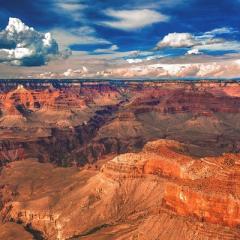
The South Rim is the Grand Canyon most people picture: the vast, layered, deep views from spots like Mather Point and Yavapai Point, inside the national park itself. It's the postcard, the desktop wallpaper, the "I can't believe this is real" view. And from Las Vegas, getting there is a commitment.
A South Rim day tour means a very early pickup — often before sunrise — and a long stretch of highway through Kingman and the old Route 66 towns before you reach the park. You'll typically get a few hours at the rim to walk between viewpoints, take photos, and grab lunch, and then you turn around and do the whole drive back. Door to door, you're looking at a 13 to 15 hour day, most of it on the bus.
The reward is real and it's the reason people still do it: the South Rim simply looks bigger and deeper than West, and it carries the genuine national-park atmosphere — pine forest at the rim, the canyon dropping away for miles. For a lot of international visitors who don't know when they'll be back in this corner of the world, the fatigue is a fair price for a once-in-a-lifetime view.
The trade-off: You sacrifice comfort and energy — the day is mostly windshield time, and it's a lot to ask of kids or anyone who tires easily. You get the deepest, widest, most iconic version of the Grand Canyon, and the satisfaction of having seen the "real" one.
How You Actually Get There: Tour Bus, Rental Car, or Helicopter
Almost every guide to this trip quietly assumes you’ll book a seat on a coach tour. Most people do, and for the South Rim it’s usually the right call. But it isn’t the only way, and at Grand Canyon West the alternative is easier than its reputation suggests.
You can drive yourself to Grand Canyon West. The route runs south out of the city on US-93, crosses the Colorado at the bypass bridge beside the Hoover Dam, then turns onto Pierce Ferry Road and Diamond Bar Road for the last stretch to the entrance. It’s roughly 125 to 130 miles depending on where you start on the Strip, and about two hours if you don’t stop.
The reason this matters is a piece of outdated advice that still circulates widely. Diamond Bar Road used to end in a rough, unpaved stretch that genuinely punished ordinary rental cars, and plenty of travel pages still warn about it. That stretch was paved in August 2014. The final nine miles were finished and the county has maintained the road since. A standard rental car handles it.
What driving yourself does not do is get you in for free. Grand Canyon West sits on Hualapai tribal land and charges admission per person regardless of how you arrive, so the saving is the tour seat, not the entry.
The South Rim is a different calculation. At roughly 275 miles each way it’s four and a half to five hours of driving before traffic, and doing it yourself means one person spends nine or ten hours at the wheel and still has to be alert for the drive home in the dark. This is the leg where the coach earns its price: someone else drives, and you arrive at the rim with something left.
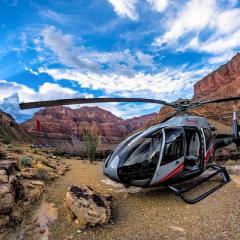
Helicopters are the third option, and they are two different products wearing one name. A flight over the Strip is a sightseeing loop that never leaves the city. A Grand Canyon flight is genuine transport — it covers in under an hour what the road does in two, and some of them land. They also cost several times a coach seat, which is the honest reason most people don’t take one.
| Getting there | 🚌 Coach tour | 🚗 Your own car | 🚁 Helicopter |
|---|---|---|---|
| Grand Canyon West | ✅ Common, hotel pickup | ✅ ~2 hrs, paved the whole way | ✅ Under an hour, some land |
| South Rim | ✅ The usual choice | ⚠️ 4.5–5 hrs each way, you drive both | ❌ Not a practical day trip |
| Who does the driving | Someone else | You, for 4 to 10 hours | Nobody |
| Admission included? | Usually — check the listing | ❌ Pay on arrival | Varies by operator |
| Distances are from the Strip and vary by a few miles depending on your hotel. | |||
The trade-off: driving yourself buys freedom over your own schedule and costs you the day’s energy and the guide’s commentary. A coach seat buys back the driving and hands over control of when you leave and how long you stand at each viewpoint. Flying buys back the hours and costs the most by a wide margin.
What It Costs to Get In, and the Fee Most Guides Haven’t Caught Up With
The two rims are not just different drives. They’re run by different owners under different rules, and since the start of 2026 that gap has widened in a way that matters most to exactly the travelers who tend to choose the South Rim.
Grand Canyon West is Hualapai land. Admission is sold as a package: a general pass that covers the shuttle between viewpoints, the walking trails and the tribe’s guided narration and performances, and a higher tier that adds the Skywalk and the zipline. There’s also a cheaper late-afternoon pass. Tickets stop selling at 4:30 in the afternoon, which is the detail that ruins the occasional late start.
The South Rim is Grand Canyon National Park, and the park charges by vehicle rather than by head: one fee covers everyone in the car and stays valid for a week, which is why it looks so much cheaper on paper for a group.
Then there’s the part that changes the arithmetic. Since January 1, 2026, visitors who are not United States residents and are aged sixteen or over pay an additional one hundred dollars per person to enter Grand Canyon National Park, on top of the vehicle fee. The surcharge applies at eleven parks and the Grand Canyon is one of them. There’s an annual pass priced separately for non-residents that becomes the cheaper route once you’re three people, or if you’re visiting more than one of those parks on the same trip.
Grand Canyon West is not a national park, so the surcharge does not apply there.
| 💵 Entry | Grand Canyon West | South Rim (national park) |
|---|---|---|
| Who runs it | Hualapai Tribe | National Park Service |
| Charged by | Per person | Per vehicle, valid 7 days |
| General entry | $67 (no Skywalk) | $35 per car, up to 15 people |
| With the headline extra | $99 (All-Access, includes Skywalk) | — |
| Late-afternoon pass | $59 (Sunset) | — |
| 🔴 Non-US resident, 16+ | No surcharge | +$100 per person (since Jan 1, 2026) |
| Payment | Card or cash | ⚠️ Card only, no cash |
| Last tickets sold | 4:30 PM | — |
| Grand Canyon West prices are before tax. Confirm at checkout. | ||
For two international visitors arriving in one car, that turns a rim choice that used to be mostly about hours into one that’s also about a couple of hundred dollars. It doesn’t automatically make West the right answer — the South Rim view is still the South Rim view, and people who came for it usually still want it. It does mean the decision deserves a second look if you assumed the national park was the cheaper option.
One practical note that catches people out: the park’s entrance stations take cards only. No cash.
The trade-off: paying the surcharge buys the view the South Rim is famous for and a pass that stays good for a week. Choosing West on cost means accepting a smaller, more managed version of the canyon — and if you’d have picked West anyway, the fee simply made an easy decision easier.
Which Rim Fits the Kind of Traveler You Are
The right rim depends less on which is objectively grander and more on who's in your group and how the rest of your trip looks.
If it's your first Vegas trip with 3 or 4 nights and the canyon is one item on a packed list, West is usually the kinder choice — you get the canyon without sacrificing a full day and a night of energy. If you're traveling with young kids, West again tends to be the less punishing option; a 5-hour bus leg each way is a hard sell for small children, and the medical reality of desert heat makes a long exposed day riskier. If you're an older traveler or someone with limited mobility, the shorter West drive and concentrated viewpoints are easier on the body than the South Rim marathon.
But if you're a nature-and-photography traveler who came specifically for the landscape, or you're visiting from overseas and may never be back in this region, the South Rim is often the trade-off worth making. The view is the reason you came, and West won't fully scratch that itch. People who've already seen other big canyons and parks in the U.S. sometimes find West perfectly satisfying as a quicker hit; first-timers chasing the iconic shot lean South.
The trade-off: Matching the rim to your group honestly means some travelers consciously skip the bigger view for a saner day, and others accept a brutal day for the bigger view. Either way, the regret comes from picking the rim that doesn't match your actual priorities — not from the rim itself.
Can You Add Antelope Canyon or Horseshoe Bend to the Same Day?
This comes up constantly, usually as a single itinerary that reads beautifully on a map: the Grand Canyon in the morning, Antelope Canyon in the afternoon, Horseshoe Bend at golden hour, back to the Strip for a late dinner.
The honest answer is no, and it’s the driving that decides it. Antelope Canyon and Horseshoe Bend are both at Page, Arizona, which is about 271 miles from Las Vegas — five and a half hours each way on its own, before you add the leg between Page and either rim. Stacking them into one day puts you past eleven hours behind the wheel before you’ve stopped anywhere.
There’s a second constraint people don’t discover until they try to book. Antelope Canyon cannot be visited on your own. It sits on Navajo Nation land, entry is only with an authorized guide, hiking in independently is prohibited, and the slots are reserved ahead. There’s a tribal permit per person per site on top of the tour itself. Turning up and walking in isn’t an option at any price.
Page works as an overnight, or as a stop on a longer loop that isn’t centered on Las Vegas. It doesn’t work as an afternoon.
What does combine cleanly is the Hoover Dam. The drive to Grand Canyon West crosses it — the bypass bridge is on the route, not a detour — so adding it costs you a stop rather than a leg. That’s the pairing worth building a day around.
The trade-off: accepting that Page is its own trip means leaving Antelope Canyon unseen on this visit. Trying to force it in means most of your day is a windshield, and you’ll arrive at the thing you drove furthest for with the least time to look at it.
Alternatives If the Canyon Day Trip Doesn't Quite Fit
Skipping the Grand Canyon on this trip isn't a failure. If the drive math doesn't work for your group or your schedule, there's a lot of dramatic landscape much closer to Las Vegas.
Red Rock Canyon is right on the edge of the city — a scenic loop drive, easy hikes, and great late-afternoon light, all doable in a half day. Valley of Fire is a bit farther but delivers a full day of striking red sandstone formations for far less driving than the South Rim. And if you want a taste of the canyon without the all-day haul, Hoover Dam combos and helicopter tours can pair big views with a landmark in a shorter window.
The honest version of this advice: it's better to choose an alternative that genuinely fits your trip than to force a South Rim day your body or schedule can't absorb. A great half day at Red Rock beats a miserable 15-hour bus day that leaves you too wrecked to enjoy the rest of Vegas.
The trade-off: Choosing a closer alternative means leaving Vegas without having seen "the Grand Canyon" — that pending-item feeling is real. You get a lighter day, genuinely beautiful scenery, and energy left for the rest of your trip.
Admission prices, entrance fees and road conditions change, and tour operators set their own schedules and rates. Figures here were verified in September 2026 — confirm current prices with Grand Canyon West, the National Park Service and your operator before you travel.
Common questions
❓ Is Grand Canyon West or South Rim better from Las Vegas?
Depends on your priority. West is closer (~125 miles, 2–2.5 hours each way), home to the Skywalk, and easy to do as a relaxed day trip that leaves you fresh for Vegas that night. South Rim is farther (~275 miles, 4.5–5 hours each way) and delivers the deep, classic canyon views most people picture — but the day runs 13–15 hours door to door. West for convenience; South Rim for the iconic view.
❓ Is the Skywalk worth it at Grand Canyon West?
It's worth it if a one-of-a-kind glass bridge over the canyon is the experience you came for — it's striking and exists nowhere else. Know the rules first: you can't carry your own camera or phone onto the Skywalk, so the only photos are the official paid ones. If you mainly want open canyon views, Guano Point at the same site delivers those for free. The Skywalk is a thrill add-on, not the whole reason to choose West.
❓ Can you drive yourself to Grand Canyon West from Las Vegas?
Yes. It’s about 125 to 130 miles and roughly a two-hour drive on paved road the whole way — the last stretch of Diamond Bar Road was paved in 2014, so a standard rental car is fine and the old warnings about a rough dirt section are out of date. You still pay Grand Canyon West admission per person on arrival; driving yourself saves the tour seat, not the entry fee.
❓ Do international visitors pay extra to enter the Grand Canyon?
At the South Rim, yes. Since January 1, 2026, non-US residents aged 16 and over pay an extra $100 per person on top of the standard entrance fee, at the Grand Canyon and ten other national parks. A non-resident annual pass costs less once you’re three or more people, or if you’ll visit several of those parks. Grand Canyon West is Hualapai tribal land rather than a national park, so the surcharge doesn’t apply there.
❓ Is the South Rim too far for a day trip from Las Vegas with kids?
For most families with young kids, yes — it's a hard day. The South Rim runs 4.5–5 hours of driving each way, which means a 13–15 hour door-to-door day with limited time actually at the canyon. That's a lot of bus time and heat exposure for small children. Grand Canyon West (2–2.5 hours each way) is the gentler family choice. If the South Rim is non-negotiable, consider an overnight stop in Williams, AZ rather than forcing it into one day.
❓ Can you visit the Grand Canyon and Antelope Canyon in one day from Las Vegas?
Realistically, no. Antelope Canyon and Horseshoe Bend are at Page, Arizona, roughly 271 miles and five and a half hours from Las Vegas each way, so combining them with either canyon rim puts you past eleven hours of driving before a single stop. Antelope Canyon also requires a booked tour with an authorized Navajo guide — independent entry isn’t permitted — so it can’t be squeezed in on arrival. Page is better as an overnight or part of a longer loop.
❓ What is the best way to get to the Grand Canyon from Las Vegas?
It depends on the rim. For Grand Canyon West you can drive yourself: about 125 to 130 miles and roughly two hours, paved the whole way — the warning about the rough stretch on Diamond Bar Road is outdated advice, since it was paved in 2014 and a standard rental handles it. For the South Rim, at around 275 miles each way, the coach earns its price, because driving yourself puts one person at the wheel for nine or ten hours. A helicopter is genuine transport to the West Rim and covers in under an hour what the road does in two, at several times the price of a coach seat. One catch either way: driving yourself does not save the admission, which Grand Canyon West charges per person however you arrive.
About the Author
Intercoper Curator Team
Travel Analysts
Our team researches and curates tour experiences. We combine local knowledge with rigorous verification to recommend only tours worth your time.